Compare
Reading the Patient, Not the Number The Five C's: A Framework for Clinical Interpretation

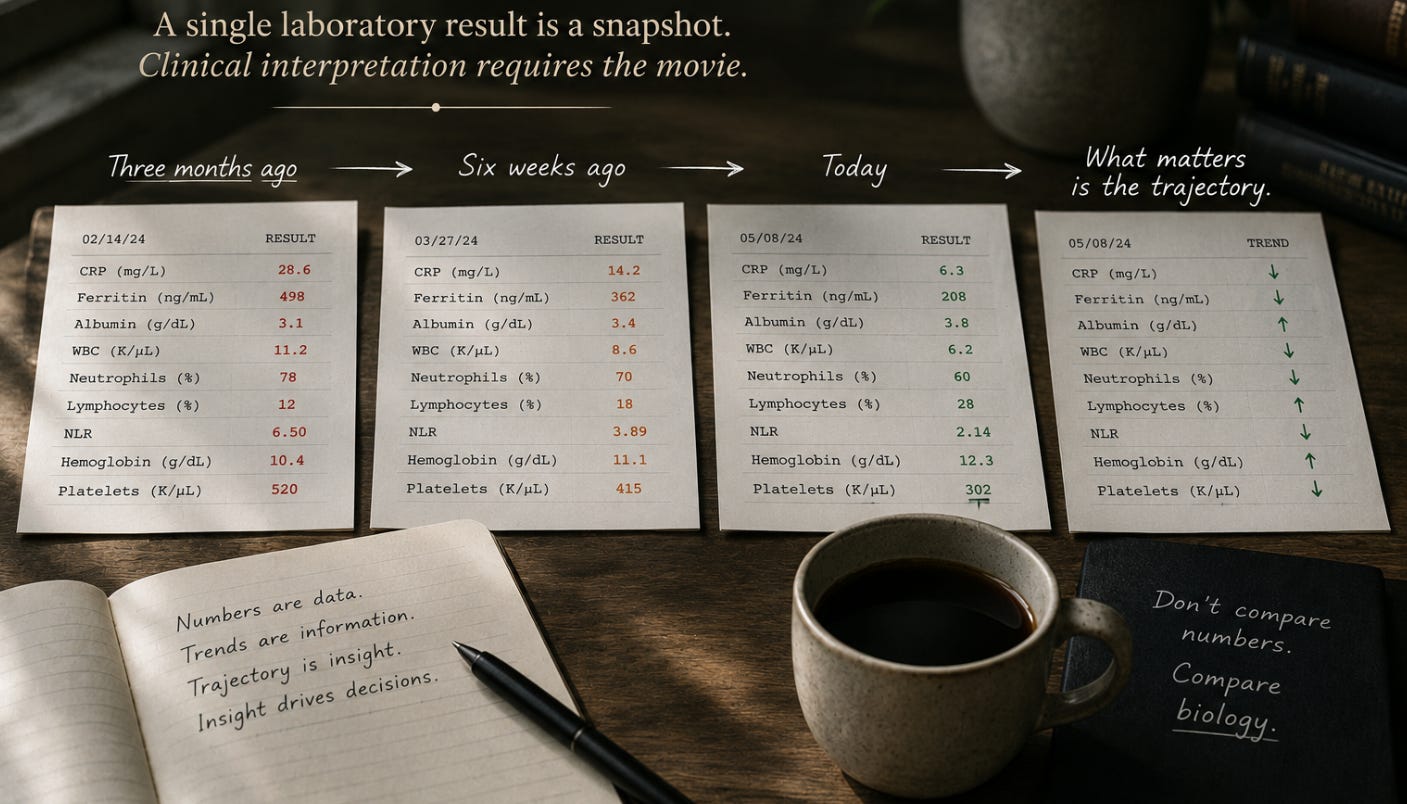
A single laboratory result is a snapshot. Clinical interpretation requires the movie.
One of the most common questions patients ask after reviewing their laboratory results is, “Is this number good or bad?”
It is an understandable question, but it is often the wrong one.
By the time we reach the fourth step in the Five C’s framework, we have already established the patient’s context, organized the laboratory findings into biological systems, and examined how those systems relate to one another. We now have a much clearer understanding of what the patient’s biology looks like today.
The next question is equally important.
Is that biology changing?
This is where comparison becomes one of the most valuable tools in clinical interpretation. A single laboratory report provides information about one point in time. It tells us where the patient is today, but it tells us very little about how they arrived there or where they may be heading. Biology is never static. Every physiological system is constantly adapting to treatment, disease progression, recovery, infection, nutritional status, and countless other influences. Laboratory values simply provide occasional snapshots of that continuous process.
For this reason, I rarely become preoccupied with whether a particular laboratory value falls just inside or just outside the reference range. What interests me much more is its direction. Is the inflammatory burden increasing or resolving? Is immune function recovering after treatment or continuing to decline? Is nutritional status improving despite ongoing therapy? Is metabolic health becoming more resilient, or are subtle signs of physiological stress beginning to emerge?
The answers to those questions are often far more clinically meaningful than the absolute number itself.
This is one of the reasons serial laboratory testing is so valuable. A single result may raise an important question, but a series of results begins to reveal a pattern. It allows us to distinguish between temporary physiological fluctuations and meaningful biological trends. It helps us recognize recovery before it becomes clinically obvious, identify deterioration while it is still subtle, and better understand whether a patient’s biology is adapting in the direction we would expect.
Consider an elevated CRP. A value of 15 mg/L has very different implications depending on what came before it. If it has fallen steadily from 80 mg/L over several months, it may represent a significant improvement in systemic inflammation despite remaining above the laboratory reference range. Conversely, if that same value has increased from 2 mg/L over a relatively short period, it may indicate a developing inflammatory process that warrants further investigation.
The number is identical.
The biological trajectory is not.
The same principle applies across virtually every physiological system. A gradual improvement in albumin may reflect recovering nutritional reserve and improved physiological resilience. A slowly declining neutrophil-to-lymphocyte ratio may suggest a reduction in systemic inflammatory stress. Even tumor markers, which often receive considerable attention, are most informative when interpreted as part of a broader trajectory rather than as isolated measurements. They may fluctuate transiently, plateau for a period of time, or change more slowly than the underlying biology itself.
Transient Movement Vs. Continuous Trajectory
Perhaps one of the most important lessons I have learned is that improvement is rarely linear.
Patients often expect recovery to occur as a straight line, with each laboratory result looking progressively better than the last. Biology rarely behaves that way. Inflammation may temporarily increase following surgery or immunotherapy before subsequently resolving. Certain immune cell populations may decline transiently as they redistribute into tissues before later recovering. Nutritional markers may remain relatively unchanged for weeks despite meaningful physiological improvements occurring elsewhere.
These temporary fluctuations do not necessarily represent failure.
They often represent adaptation.
Understanding that distinction requires more than comparing numbers. It requires comparing biology.
This is where clinical judgment becomes increasingly important. Comparison is not simply the process of identifying what increased and what decreased. It is the process of determining whether those changes make physiological sense within the context of the patient’s disease, treatment, and overall clinical picture. Sometimes the expected changes occur. Sometimes they do not. Both observations are equally informative because both deepen our understanding of what the patient’s biology is doing.
Ultimately, comparison allows us to move beyond static interpretation. Rather than asking what the laboratory values look like today, we begin asking where the biology is going. That shift in perspective changes the way we think about laboratory medicine. It transforms isolated snapshots into a moving picture and allows us to follow the patient’s biological journey rather than simply documenting individual moments along the way.
Only after understanding the patient’s context, organizing the biology into systems, recognizing the relationships between those systems, and appreciating how they change over time are we prepared for the final step in the framework.
Drawing a clinical conclusion…